Wednesday, October 9, 2019

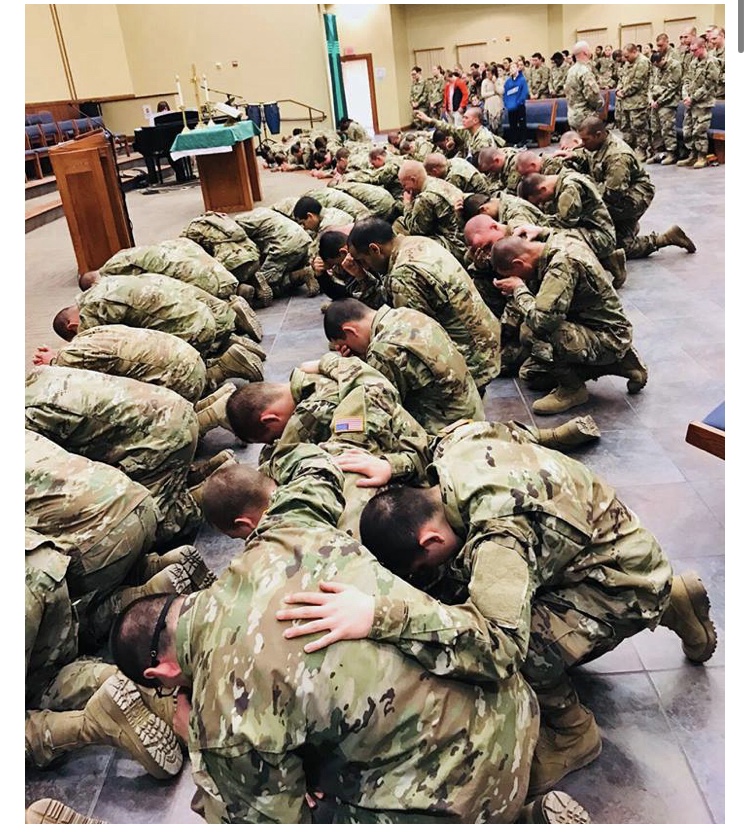
Revival hits army base with 1459 receiving Christ


Revival hits army base with 1459 receiving Christ


Army Chaplain Jose Rondon believes “there is nothing more exhilarating in life than seeing people come to Christ.” In the last six months, Rondon has experienced that exhilaration with more than 1,400 professions of faith — something one could describe as a spiritual awakening — at Fort Leonard Wood, his place of ministry.
Because of his reputation for being intentional in his ministry, many have come to hear Rondon share the Gospel on Sundays.
We have seen 1,459 soldiers come to Christ since March of this year,” Rondon said. “God is doing great things at Fort Leonard Wood among the hundreds of soldiers who have come to know Christ personally.”

Retired Major General Doug Carver, executive director of chaplaincy for the North American Mission Board, says what is happening at Fort Leonard Wood is not an exception. Right now there are reportedly 1,348 military chaplains in the Southern Baptist Convention at work.
“Our troops, who are increasingly hungry for truth and relevancy in their lives, are finding a faith that works through a personal relationship with the Lord Jesus Christ,” Carver said. “The current spiritual awakening at Fort Leonard Wood is indicative of a great move of God taking place within the Armed Services today.”

Consider the following, Carver reported:
— More than 2,000 troops gathered in Doughboy Stadium at Fort Benning, Ga. this past Easter to celebrate the Resurrection of Jesus Christ.
— Army chaplains are currently baptizing an average of 70 soldiers every basic combat training cycle at Fort Jackson, S.C.
— The U.S. Air Force Chaplaincy recently rolled out a new program called FaithWorks, which is a collection of evidence-based programs and materials promoting spiritual resilience for airmen and their families.
— The military has built more chapels since 9/11 than any other period of American history except for World War II.

Sunday, October 6, 2019

PROTESTA Y DISCURSO ENFRENTE LA JCE - LEONEL FERNÁNDEZ, LA GUERRA SIGUE


TRIBUNAL SUPERIOR ELECTORAL) RECHAZA INSTANCIA SOMETIDA POR LEONEL QUE BUSCABA EVITAR PROCLAMACION DE GONZALO


Una prolongada audiencia que se extendió por más de 12 horas, el Tribunal Superior Electoral rechazó esta madrugada (4:40) una instancia sometida por el aspirante a la Presidencia de la República, Leonel Fernández, en la que pedía que no se proclamara a Gonzalo Castillo como ganador de las primarias hasta tanto no se realizara una auditoría forense a los equipos que se utilizaron en el proceso del pasado domingo.


En ese sentido, dictaminó que Fernández debe acatar la proclamación de Castillo como ganador de las primarias. 
El alto tribunal, integrado por los jueces Román Jáquez Liranzo, presidente; Rafaelina Peralta, Ramón Arístides Madera Arias, Cristian Perdomo y Santiago Sosa, tomó la decisión al considerar que “la parte demandante no logró demostrar que los daños invocados sean irreparables”. La decisión fue tomada con el voto disidente del magistrado Madera Arias.
El TSE mantuvo anoche en vilo al país durante el conocimiento de la demanda en referimiento de extrema urgencia que presentó el miércoles en la tarde el expresidente Leonel Fernández, en reclamo de la suspensión de la divulgación del cómputo definitivo y de la proclamación de Castillo, su principal contendor.
A través de su defensa legal, Fernández insistió ayer ante los jueces del TSE que el sistema de voto automatizado que utilizó la Junta Central Electoral (JCE) en la primarias del pasado domingo fue manipulado.
En una sala de audiencia repleta de peledeítas de las dos precandidaturas, el abogado Manuel Fermín, quien coordina el consejo de defensa del expresidente Fernández, precisó que más de 2,000 equipos del proyecto de voto automatizado no fueron utilizados y que la JCE nunca informó de esa situación.
Además, se apoyó en el informe del movimiento Participación Ciudadana, que observó el proceso, en el que constató que durante las votaciones se produjeron irregularidades, como la compra de cédulas y la inconsistencia de los votos automatizados con los físicos en muchos recintos.
Fermín fue el primero que intervino, al reanudarse la audiencia a las 4:00 de la tarde, después de un aplazamiento dispuesto por el TSE a las 11:30 de la mañana para la comunicación recíproca de documentos, a solicitud de la JCE.
El órgano encargado de la organización de las primarias está demandado junto con el PLD y Gonzalo Castillo, a quien los datos preliminares lo perfilan como ganador de la candidatura presidencial en las primarias celebradas por ese partido.
Cuando el presidente del TSE, Román Jáquez Liranzo iba a anunciar el aplazamiento de la audiencia, se produjo un apagón que duró segundos, lo cual llamó la atención en la sala.
Rechazaron recursos
El TSE se declaró competente para conocer el recurso sometido por Fernández, quien busca que Castillo no se proclame como ganador de las primarias del pasado domingo, hasta tanto no se les realice una auditoría forense a los equipos que se utilizaron en el proceso.
Los magistrados, quienes votaron la decisión a unanimidad, entendieron que el tribunal tenía competencia para conocer el recurso sometido por el equipo de Fernández, al señalar que es uno de los principales candidatos que considera ilegítimo el proceso.
Pedidos de Leonel
A través de su defensa legal, el precandidato a la presidencia por el Partido de la Liberación Dominicana (PLD), Leonel Fernández, insistió ayer ante los jueces del Tribunal Superior Electoral (TSE), que el sistema de voto automatizado que utilizó la Junta Central Electoral (JCE) en la primarias del 6 de octubre fue manipulado, durante el conocimiento de la demanda en referimiento de extrema urgencia que presentó el miércoles en la tarde en reclamo  de la suspensión de la divulgación del cómputo definitivo y de la proclamación de Gonzalo Castillo, su principal contendor.
Audiencia continuaba
Pasadas las 12:30 de la noche, las partes contiuaban exponiendo ante los jueces y no se informó si la decisión era terminar la audiencia en la madrugada y fallarla, o si por el contrario se tomaría algún receso.
Resultados de primarias
El conteo electrónico de la JCE de las primarias del pasado domingo arrojó que el precandidato presidencial del PLD con mayor votación fue Gonzalo Castillo, quien obtuvo 911,993, equivalentes al 48.70%, mientras que Leonel Fernández quedaba por debajo con 885,233, igual al 47.28%.
SEPA MÁS
Barra de Leonel El expresidente Leonel Fernández fue representado por Manuel Fermín Cabral, Namphy Rodríguez, Manuel Núñez, Manuel Ulises Bonelly, Eduard Veras Vargas, Daniel Beltré y Daniel Beltré Acosta.
Defensa PLD La barra de defensa del PLD la integran los abogados Julio Cury, Eduardo Jorge Prats, Cristóbal Rodríguez, Carlos Salcedo y Rubén Puntier.
- LISTIN DARIO 10/11/19


10/9/19

Leonel Fernández sometió a Gonzalo Castillo, a la JCE y al PLD ante el Tribunal Superior Electoral

La acción es en referencia a las primarias abiertas


Santo Domingo.- El Tribunal Superior Electoral (TSE) conocerá mañana una acción de extrema urgencia incoada por el expresidente Leonel Fernández contra la Junta Central Electoral (JCE), el Partido de la Liberación Dominicana (PLD) y el precandidato de esa organización, Gonzalo Castillo.
La acción es en referencia a las primarias abiertas y simultáneas para la elección de la candidatura para el nivel presidencial del PLD realizadas el pasado domingo.


Después de reunirme con mi equipo político, hemos decidido ejecutar mañana una serie de acciones para defender la voluntad popular, que inician con la convocatoria de los observadores internacionales y el cuerpo diplomático acreditado en el país. 
- LEONEL FERNANDEZ 


2020 se ejecutarían los fraudes mas grandes de la historia dominicana, fraudes legales,  protegidos por la Ley 169-14;   vimos en muchos centros de votación las filas de haitianos ejerciendo el voto con descaro, haitianos que apenas hablaban el español, si Leonel Fernández se hubiera opuesto a la ley 169-14, hoy  hubiera ganado las elecciones internas del PLD, la diferencia no llega a los 12 mil votos y el registro de los haitianos supera los 800 mil a los cuales se les ha dado cedulas para votar.


Leonel debería haber abogado por el voto de la diáspora. Ahora pensará en todos sus errores.

Leonel por destruir al país con la agenda global de la OEA, los Clinton, Soros y agencias Europea, le han pagado con las mismas monedas, sin embargo lo considero el vencedor aunque haya perdido. 

Court Rules All Florida Cities Must Cooperate With ICE Miami, FL – A federal district court judge has upheld a majority of the components of a new Florida state law that banned sanctuary cities and ordered law enforcement officers to continue cooperating with U.S. Immigration and Customs Enforcement (ICE).


Court Rules All Florida Cities Must Cooperate With ICE

Miami, FL – A federal district court judge has upheld a majority of the components of a new Florida state law that banned sanctuary cities and ordered law enforcement officers to continue cooperating with U.S. Immigration and Customs Enforcement (ICE).

Miami U.S. District Court Judge Beth Bloom issued the order on Monday – one day before SB 168 went into effect, the Miami Herald reported.

In addition to banning sanctuary cities throughout the state, the new law also requires law enforcement agencies to hold inmates for an additional 48 hours to provide ICE enough time to respond to take custody of them.


https://defensemaven.io/bluelivesmatter/news/court-rules-all-florida-cities-must-cooperate-with-ice-4pBWfx-pdUC83F-201k-UQ/

Saturday, October 5, 2019


Rep. Alexandria Ocasio-Cortez, D-N.Y., is promoting a new package of left-wing economic policies, including national rent control and expanding welfare to illegal immigrants across the country, as part of a massive new proposal aiming to achieve a “just society.”

“The Place to Prosper Act” would prevent year-over-year rent increases of more than three percent. Meanwhile, “The Embrace Act” would allow illegal immigrants to claim the same welfare benefits as U.S. citizens and those immigrants here “Notwithstanding any other provision of law ... 

An individual who is an alien (without regard to the immigration status of that alien) may not be denied any Federal public benefit solely on the basis of the individual’s immigration status,” the bill 

A federal public benefit is defined as: “any grant, contract, loan, professional license, or commercial license provided by an agency of the United States or by appropriated funds of the United States; 

and...any retirement, welfare, health, disability, public or assisted housing, postsecondary education, food assistance, unemployment benefit, or any other similar benefit for which payments or assistance are provided to an individual, household, or family eligibility unit by an agency of the United States or A similar bill “The Mercy in Re-entry Act” uses similar language to stop the granting of public benefits based on whether a person was convicted of a criminal It is unclear how such a radical package would go down in the Democrat-controlled House, while it would almost certainly be dead on arrival in the Republican-controlled Senate. However, it could still prove to have a significant influence on U.S. politics.

Friday, October 4, 2019

GUN GRAB - RED FLAG LAWS


Thanks to Second Amendment supporters around the Commonwealth ceaselessly voicing their opposition to a sweeping gun ban, the Senate Judiciary Committee voted 10-5 to reject House Bill 961 on February 17th. Bloomberg’s House majority in the General Assembly is not going to deliver their most coveted agenda item to their billionaire master.
View Related Articles
House Bill 961 was a comprehensive ban on many commonly-owned semi-automatic firearms, suppressors, and standard capacity magazines. The original bill sought to impose a licensing and registration scheme for citizens who wish to keep affected firearms they lawfully owned prior to the ban, with felony penalties for noncompliance. It also broadly banned any part that could be used to change a firearm into a banned configuration. While the House Public Safety Committee amended the bill to allow citizens to keep currently owned firearms and suppressors, there was no option for citizens to keep their lawfully acquired magazines with capacities greater than twelve rounds, forcing millions of Virginians to dispose of their property, become a criminal, or surrender them to the government. 


In the United States, a red flag law is a gun control law that permits police or family members to petition a state court to order the temporary removal of firearms from a person who may present a danger to others or themselves. A judge makes the to issue the order based on statements and actions made by the gun owner in question.[1]Refusal to comply with the order is punishable as a criminal offense.[2][3] After a set time, the guns are returned to the person from whom they were seized unless another court hearing extends the period of confiscation.[4][5][6]


Orders issued under "red flag" laws, also called risk-based gun removal laws,[7] are known by several names, including Extreme Risk Protection Orders (ERPOs) (in OregonWashingtonMaryland, and Vermont); Risk Protection Orders (in Florida); Gun Violence Restraining Orders (GVROs) (in California); risk warrants (in Connecticut); and Proceedings for the Seizure and Retention of a Firearm (in Indiana).[8] As of August 2019, 17 states and the District of Columbia have passed some form of red-flag law. The specifics of the laws, and the degree to which they are utilized, vary from state to state.[9]

This Awful House Bill Would Promote Gun Confiscation Without Due Process

The bill would make the criteria for federal grants loose enough to accommodate even the worst "red flag"


 https://youtu.be/NhgtqSPh06I


BILL
1. S.506 — 116th Congress (2019-2020)Extreme Risk Protection Order Act of 2019Sponsor: Sen. Feinstein, Dianne [D-CA] (Introduced 02/14/2019) Cosponsors: (28Committees: Senate - Judiciary Latest Action:  Senate - 02/14/2019 Read twice and referred to the Committee on the Judiciary. (All ActionsTracker: INTRODUCED 
                     51 Majority


Senator Dianne FeinsteinDemocrat of California, introduced a bill, the Extreme Risk Protection Order Act (S. 506), which would allow states to use grants to develop red flag laws. The legislation is supported by 25 Democratic senators and two Democratic-aligned independent senators.[63][64] Senator Marco RubioRepublican of Florida, introduced a separate bipartisan bill that would use grants to encourage the passage of state red-flag laws.[63] Senator Lindsey Graham, Republican of South Carolina, said in 2019 that he also planned to introduce legislation to encourage states to pass red flag laws.[47] Another proposed federal red flag law is Rep. John Katko's Protecting our Communities and Rights Act,[65] which places on the State or petitioner "the burden of establishing by clear and convincing evidence that the respondent poses an imminent, particularized, and substantial risk of unlawfully using a firearm to cause death or serious physical injury to himself or herself or to another person."[66]
S. 506 and other proposed bills would add persons subject to extreme risk protection orders to the list of "prohibited persons" in 18 U.S.C. § 922(g) (those persons who are prohibited from possessing a firearm).[67] The legislation would thus make "it a federal crime for persons subject to the orders to possess firearms and for anyone else who has reasonable cause to know about the orders to sell or give firearms to them."[67] In September 2019, the House Judiciary Committeeapproved amendments to the federal red flag bill to create a national red flag process.[68]
This week the House Judiciary Committee approved the Extreme Risk Protection Order Act. The legislation would provide grants to encourage the passage and enforcement of "red flag" laws, which are supposed to prevent people from possessing firearms when they are deemed a threat to themselves or others. The bill's standards for grant eligibility vividly illustrate the due process issues raised by such laws. Far from encouraging states to include robust due process protections, the bill would encourage them to slap together the weakest elements of the existing statutes.


The original version of the bill, which was introduced by Rep. Salud Carbajal (D–Calif.) in February, included very loose criteria for red flag laws. An amendment by House Judiciary Committee Chairman Jerrold Nadler (D–N.Y.) made the bill even more permissive.
In Nadler's version, petitioners—who, depending on the state, may include a long list of relatives and acquaintances as well as police officers and prosecutors—could obtain an ex parte gun confiscation order if a judge decides there is "reasonable cause" to believe the respondent "poses a danger of causing harm" to himself or others. That determination would be made without any input from the respondent, who at this stage is not notified and has no opportunity to rebut the claims against him. Contrary to the bill's name, the danger the respondent allegedly poses would not need to be "extreme," substantial, or even significant. Furthermore, no time frame is specified, so the risk would not have to be imminent, which you might think would be a requirement for an ex parte That initial order could last up to a month, at which point the respondent would finally get a hearing, although he wouldn't have a right to legal representation if he can't afford it. The judge could issue a final order if, based on "a preponderance of the evidence," a respondent seems to pose "a danger" to himself or others. 

Again, any level of risk would do, and the danger could be near or distant. The order could last "for a specified period of time" or until terminated by another order—i.e., indefinitely. Given the standard of proof (which is equivalent to any probability greater than 50 percent) and the level of danger required (anything greater than zero), respondents could lose their Second Amendment rights for a year—or longer, depending on what state legislators decide to allow—even if it was 99.9 percent certain that they never would have hurt themselves or anyone else.
The minimum standards prescribed by Nadler's bill seem to have been crafted so that all the jurisdictions that already have red flag laws—17 states and the District of Columbia—could qualify for grants. The bill thus would lower the bar to the level of the jurisdictions with the weakest due process protections.

In every jurisdiction but two, for example, an ex parte order is supposed to be based on a risk that is "imminent," "immediate," or "in the near future." Nadler's bill dispenses with that requirement, the better to accommodate D.C. and Massachusetts. The usual time limit on ex parte orders under the existing laws ranges from one to three weeks, with 14 days the most common choice (although ex parte orders can last up to 45 days in Delaware and up to six months in Maryland if they are extended). Nadler's limit is 30 days.
More than three-quarters of existing red flag laws require "clear and convincing evidence" for a final order. Nadler's bill says the weaker "preponderance of the evidence" standard is fine, so D.C., Hawaii, Massachusetts, and New Jersey needn't worry about missing out on federal money. Even among those looser jurisdictions, all but Massachusetts require a "significant" danger, which is hard to define but is at least more than any danger at all, the standard set by Nadler's bill.
Finally, Nadler's bill imposes no limit at all on the length of final orders, which under existing laws generally last a year (although they can be renewed in most of the states for another year). The two exceptions are Indiana and New Jersey, where gun confiscation orders last until the respondent files a petition and persuades a judge that he does not pose a danger to himself or others. Under Nadler's bill, that's fine too.
Sen. Lindsey Graham (R–S.C.), who plans to introduce a similar bill in the Senate, has dismissed critics of red flag laws as "libertarians." But he also has promised that his bill will include standards aimed at protecting Americans' Second Amendment rights. He will have to do a lot better than Nadler if he wants to be taken seriously.
Sen. Marco Rubio (R–Fla.) has already introduced the Extreme Risk Protection Order and Violence Prevention Act, which he brags about in today's New York Times. Rubio's bill is notably better than Nadler's in several ways but still does not set standards that provide adequate protection for people accused of posing a threat.